
Setting up product variations one by one across a large WooCommerce catalog is one of the most repetitive tasks a store owner can face. If you sell t-shirts in sizes Small, Medium, and Large with colors Red, Blue, and White, you should not have to configure those variations from scratch for every single product.
In this tutorial, you’ll learn how to copy WooCommerce product variations and attributes from one product to other products using WP Sheet Editor. You can copy to a handful of products individually, or apply the same variations to hundreds of products at once using keyword, category, tag, or attribute filters.
This approach is useful when:
- You are setting up a new WooCommerce store and most of your variable products share the same attribute structure.
- You are importing products from a supplier and need to apply a standard variation set across a large group.
- You are converting simple products into variable products and want to apply an existing variation structure without rebuilding it manually.
- You need to add a new size, color, or other attribute option to a group of existing products at once.
Instead of opening each product individually, configuring attributes, and creating variations one by one, you can set up a single product correctly and use it as a template for the rest of your catalog.
Video Guide
Install WP Sheet Editor
You can skip this step if you already have the plugin installed and activated.
WP Sheet Editor provides a spreadsheet interface for managing WooCommerce products directly inside WordPress. Instead of navigating through individual product pages, you get a single grid where you can view and edit all product data at once, including prices, stock levels, descriptions, categories, attributes, and more.
In addition to standard bulk editing, the plugin includes dedicated tools for working with product variations. The Create variations tool lets you generate new variations in bulk or copy an entire variation structure from one product to others, including all variation fields added by third-party plugins.
You can download the plugin here:
Download WooCommerce Products Spreadsheet Plugin - or - Check the features
After installing and activating the plugin, go to WP Sheet Editor > Edit Products to open the products spreadsheet. You will see all your WooCommerce products loaded into the grid with their complete data.
If you want to see product variations displayed alongside their parent products in the spreadsheet, click the Display variations button in the toolbar. This is useful for reviewing variation data before and after copying.

1. Copy Variations to Individual Products
Use this method when you want to copy variations from one source product to one or a small number of specific target products. This is the right approach when you need control over exactly which products receive the variation copy.
For example, you might have three new t-shirt products that should share the same size and color variations as an existing product. Rather than building those variations from scratch on each new product, you can copy them directly from the existing one.
To begin, open the Create variations tool by clicking it in the toolbar.

The tool displays two options: create variations and copy variations. Click Copy variations.
Configure the following values:
- Enter the source product in the Copy variations and attributes from this product field. This is the product whose variations you want to replicate.
- Enter the target products in the The variations are for these products field. You can specify one product or several.
- Click Execute.

The plugin will copy all variations from the source product, including their attributes, prices, stock levels, SKUs, images, and any custom fields added by other plugins, to each of the products you specified.
After the operation completes, click Display variations in the toolbar to confirm that the variations now appear on the target products in the spreadsheet.
Advanced Options
Tick Show advanced options to access additional settings that give you more control over what gets copied and how it is applied.
- Use prices from simple product (parent) on the variation: This option is useful when converting simple products into variable products. Instead of applying the source variation’s prices to the new variations, the plugin will use the existing price from each target simple product. This preserves the pricing already set on those products while still copying the attribute and variation structure.
- Do not copy the variation images: Copies all variation data except the variation image. Use this when your target products have different images that should not be replaced by the source product’s variation images.

2. Copy Variations from One Product to Hundreds of Products
Use this method when you need to copy the same variation structure to a large group of products at once. Instead of specifying products one by one, you define a filter by keyword, category, tag, attribute, or status, and the tool applies the copy to every product that matches.
This is particularly useful in situations like these:
- You have imported a large number of simple products from a supplier and need to convert them all to variable products with the same size and color options.
- You added a new variation to one product in a category and now need to push that variation to all other products in the same category.
- You manage a catalog where all products sharing a keyword, such as “hoodie”, should have identical variation sets.
To begin, open the Create variations tool from the toolbar.
Click Copy variations, then configure the following:
- Enter the source product in the Copy variations and attributes from this product field.
- Select Multiple products in the The variations are for these products field.

Selecting Multiple products opens an inline search tool. Use any of the following filter options to find your target products:
- Contains keyword: Find all products whose title contains a specific word or phrase. For example, entering “shirt” will match all products with “shirt” in the name.
- Status: Filter by Published, Draft, Scheduled, or other product statuses. This is useful when you want to copy variations only to products that are already live, or only to drafts you are preparing before publishing.
- Enter Tags: Filter by categories, attributes, tags, or shipping classes. This lets you target a well-defined product group without relying on naming conventions.
You can combine multiple filters to narrow the results further. Once you have configured your filter, click Run search to load the matching products.
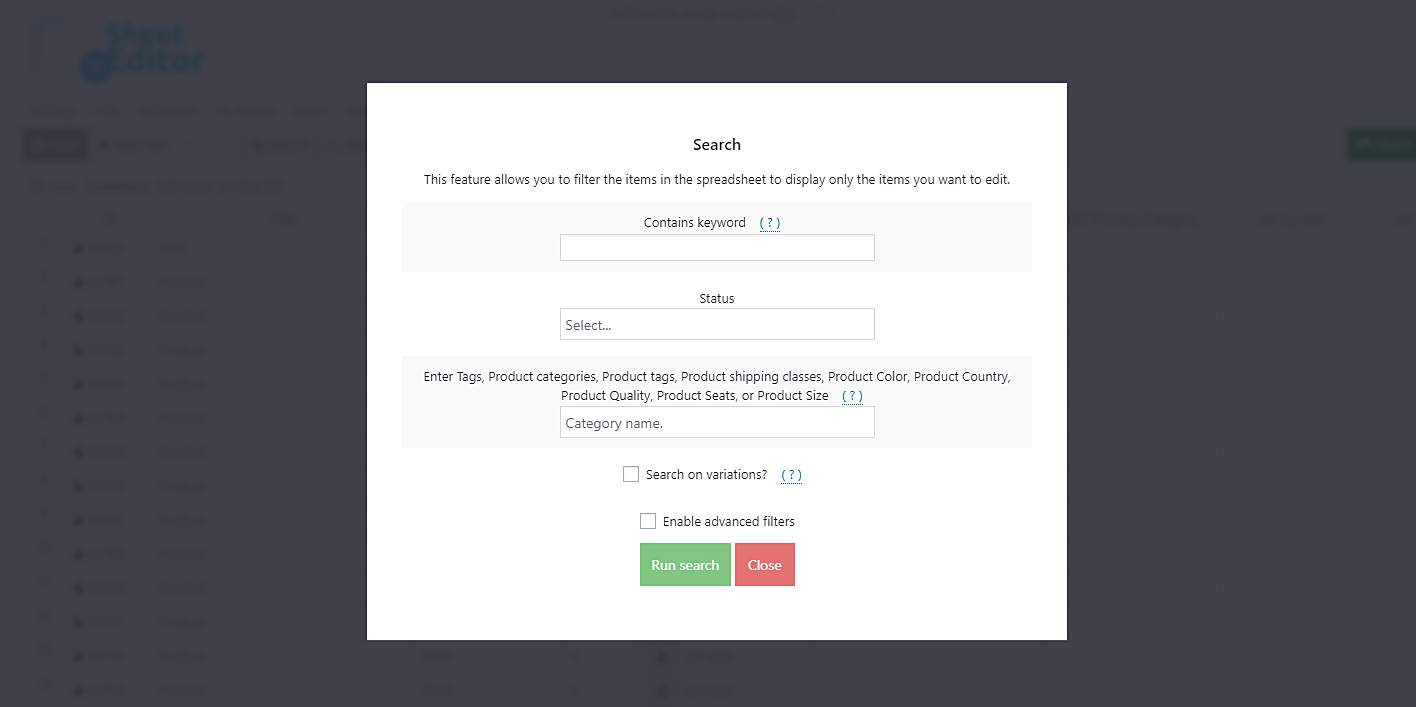
Review the search results to confirm you have the right products selected, then click Execute to copy the variations to all matching products.

The copy includes all variation fields, including any custom fields added by other plugins. Once the operation completes, you can use the Display variations button to verify that the variations appear correctly on the target products.
Advanced Options
Tick Show advanced options to access the same additional settings available for individual product copying:
- Use prices from simple product (parent) on the variation: Retains the price from each target simple product rather than applying the source variation’s price. This is the recommended option when converting a group of simple products into variable products, since each product may already have a distinct price you want to preserve.
- Do not copy the variation images: Copies all variation data except images. Useful when your target products each have their own product images that should not be replaced.
3. Copy Only Specific Variations
In some cases, you do not need to copy the entire variation set from a source product. For example, you may only want to add the “Large” size variation to a group of products that already have Small and Medium, or you may want to copy only the “Red” color variation without affecting the other colors already configured on the target products.
This option works for both individual and multiple product targets. Configure the following values:
- Enter the source product in the Copy variations and attributes from this product field.
- Tick the I don’t want to copy all the variations checkbox.
- Select the specific variations you want to copy in the Which variations do you want to copy field. The list will show all available variations from the source product.
- Select Individual or Multiple products in the The variations are for these products field, depending on whether you are targeting specific products or a filtered group.
- Click Execute.

This gives you control over what gets added to the target products without disturbing the variation data that already exists on them.
Tips and Best Practices
Before running a large copy operation, a few precautions can help avoid problems:
- Verify the source product first. Make sure the product you are copying from has all the correct attributes, variation data, prices, and stock levels configured before using it as a template. Any errors in the source product will be replicated across all target products.
- Test on a small group first. Before copying to a large number of products, try the operation on two or three target products and confirm the results look correct in the spreadsheet.
- Consider server capacity. Copying variations to many products at once requires server resources proportional to the number of targets. If your server has limited resources, work in smaller batches to avoid timeouts.
- Use Display variations to confirm results. After the operation completes, click Display variations in the toolbar to expand variation rows in the spreadsheet and verify that the copied data looks correct across your target products.
You can download the plugin here:
Download WooCommerce Products Spreadsheet Plugin - or - Check the features