
In this tutorial, we will show you how to automatically translate WordPress posts using AI and WPML.
A multilingual WordPress site helps your content reach a wider audience around the world. It allows visitors to read your posts in their own language, which increases engagement and helps your site rank for more keywords in different regions.
However, managing a website in multiple languages can be challenging, especially when you need to translate hundreds of posts into several languages. But with WP Sheet Editor – AI, you can now translate all your posts using artificial intelligence directly in an intuitive spreadsheet. It’s the perfect multilingual AI translation tool for WordPress.
Using AI to translate your content saves you time and money, as you can do it in just a few minutes without hiring external translators.
Table of Contents
Tools to translate WordPress posts with AI
Note: We assume you already have these plugins installed and activated on your WordPress site:
1- WP Sheet Editor – Post Types Spreadsheet
This plugin allows you to view and edit hundreds or thousands of posts, pages, and custom post types in a spreadsheet within WordPress. It includes advanced search, bulk edits, and CSV/Excel import/export tools.
You can download the plugin here:
Download Posts, Pages, and Custom Post Types Spreadsheet Plugin - or - Check the features
2- WP Sheet Editor – AI
WP Sheet Editor – AI integrates AI into all WP Sheet Editor spreadsheets. You can quickly create, edit, and translate WordPress content in bulk with just a few clicks.
You can sign up here:
Sign up to the WP Sheet Editor - AI Service - or - Check the features
3- External AI Provider
The AI functionality relies on an external API like OpenAI, OpenRouter, or other compatible services. You’ll need an account and API key to connect. WP Sheet Editor – AI supports:
- OpenAI for text and images (more info)
- OpenRouter (more info)
- Other providers compatible with OpenAI API format
Follow this guide to set up AI providers in WP Sheet Editor – AI.
Open the WordPress posts spreadsheet
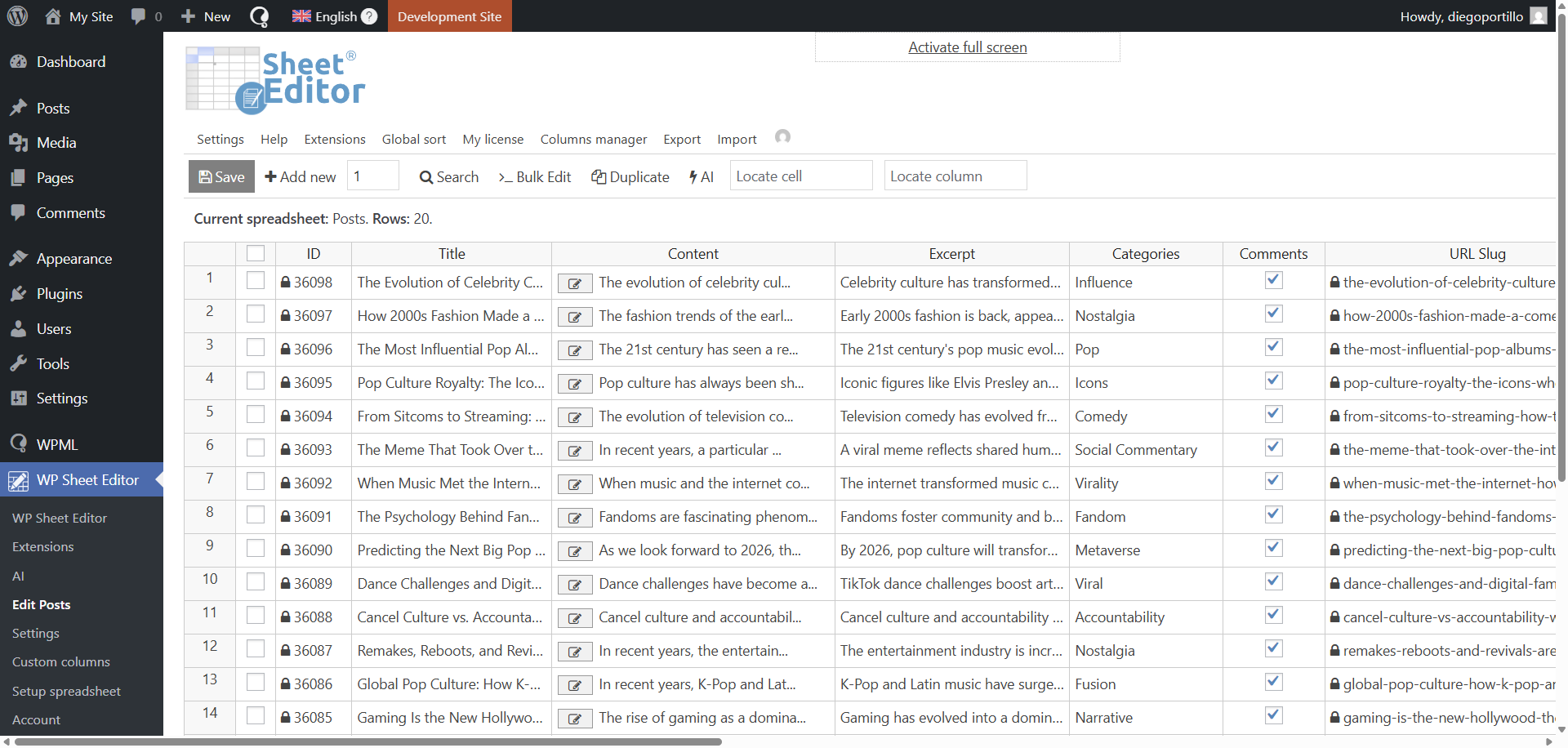
To edit posts, go to WP Sheet Editor > Edit Posts. The spreadsheet will display your posts based on the WPML language selected in the admin bar. Here are the posts in our original language (English).
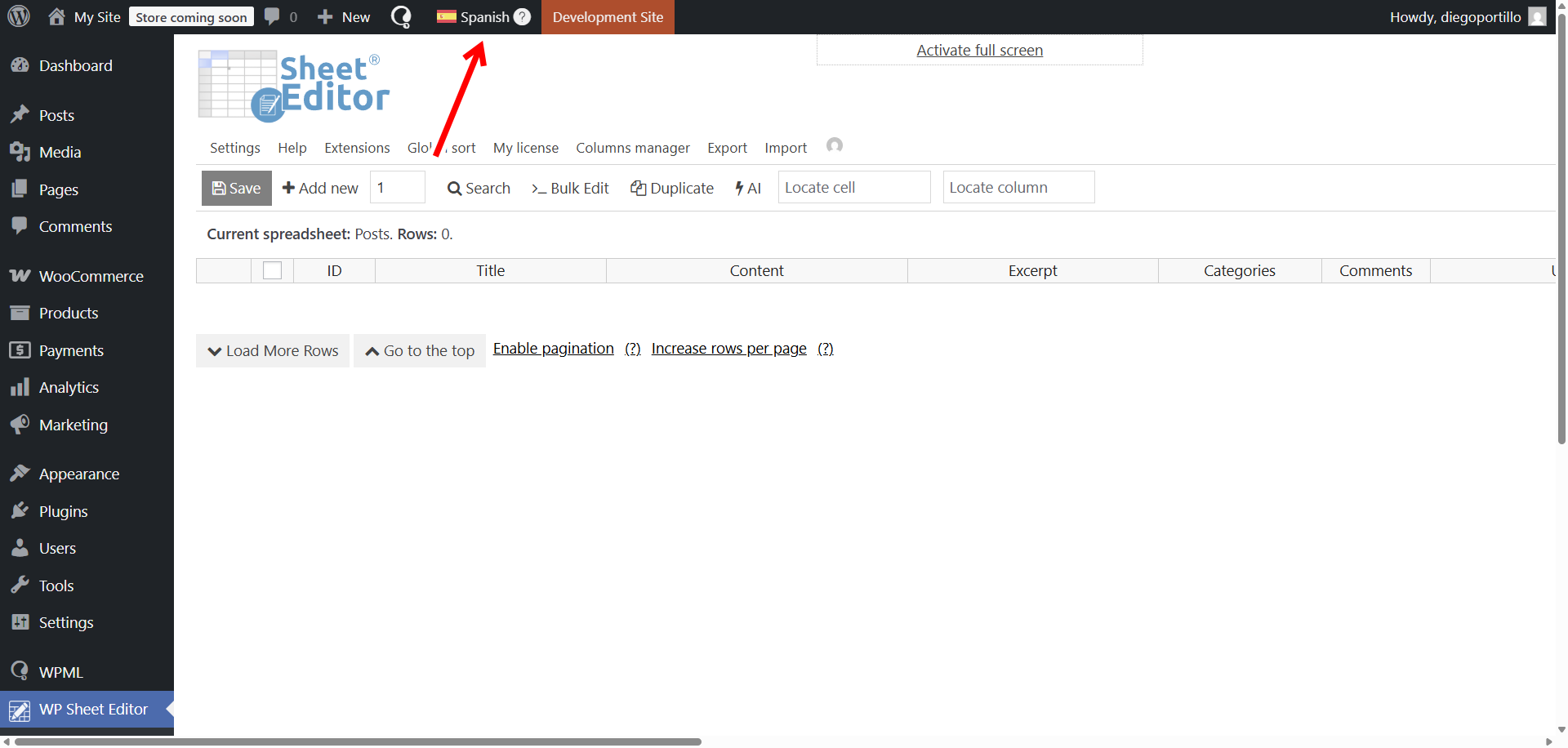
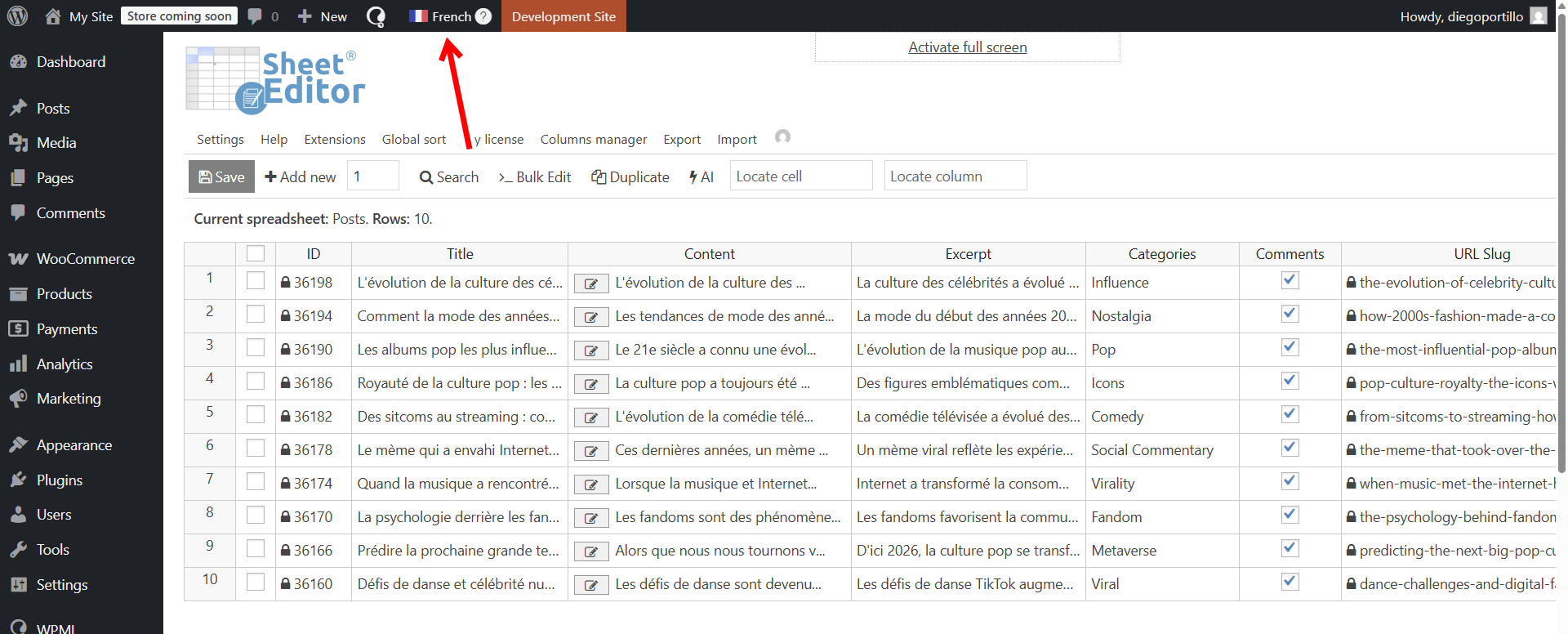
If we switch the language in the admin bar to Spanish or French, we can see that no translations exist yet for those languages.
Automatic AI translation of WordPress posts
WP Sheet Editor – AI provides a new dedicated column for automatically translating WordPress posts with AI: AI – WPML Auto translate to languages. This column allows you to automatically translate all post fields supported by WPML: titles, content, excerpts, SEO data, and custom fields — all without writing prompts manually.
Here’s how it works:
Option 1 – Auto translate with AI in the spreadsheet
Open the WordPress posts spreadsheet in the main language (e.g., English).
Locate the AI – WPML Auto translate to languages column in the spreadsheet.
Enter the language codes you want to translate into (for example: “es” for Spanish, “fr” for French, “it” for Italian, etc.)
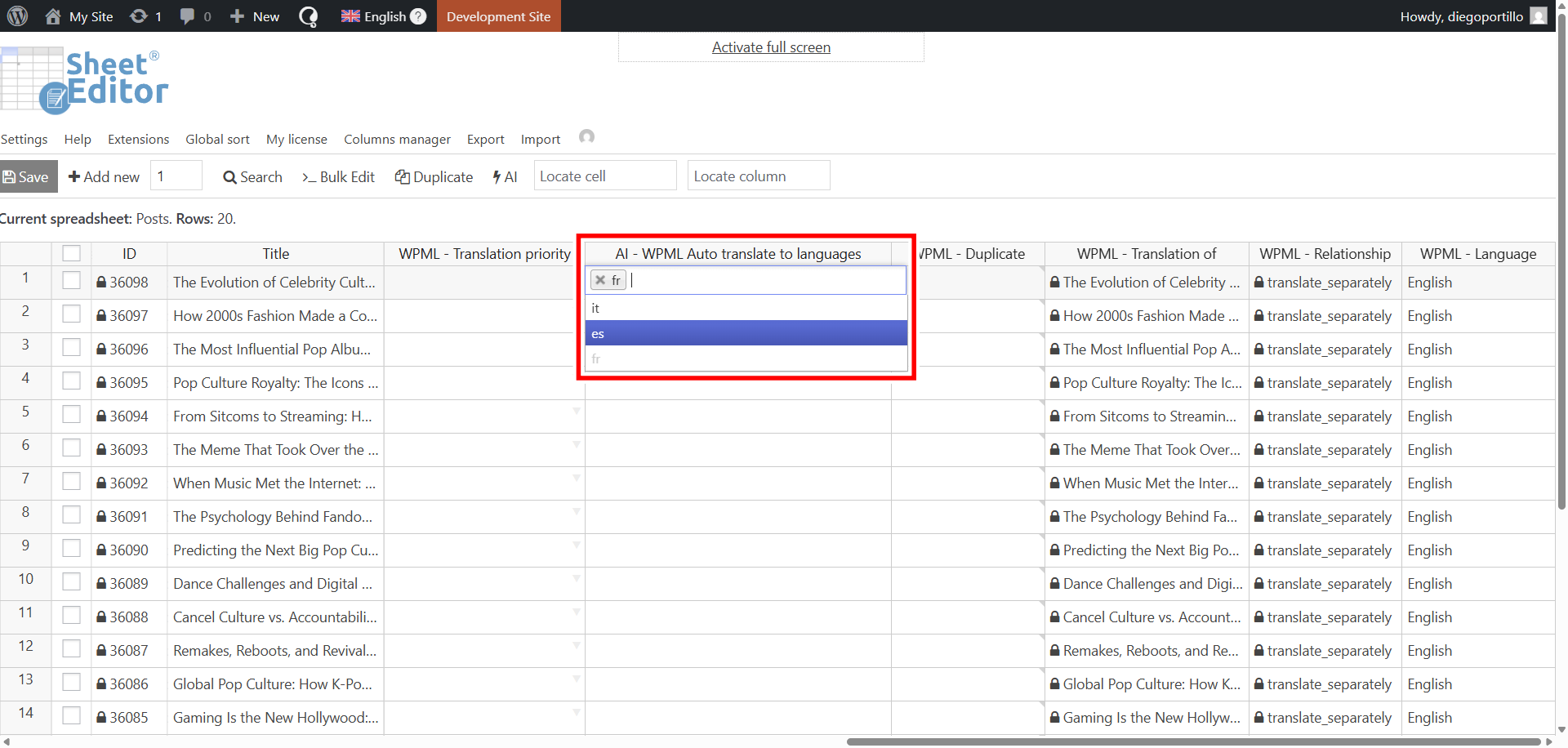
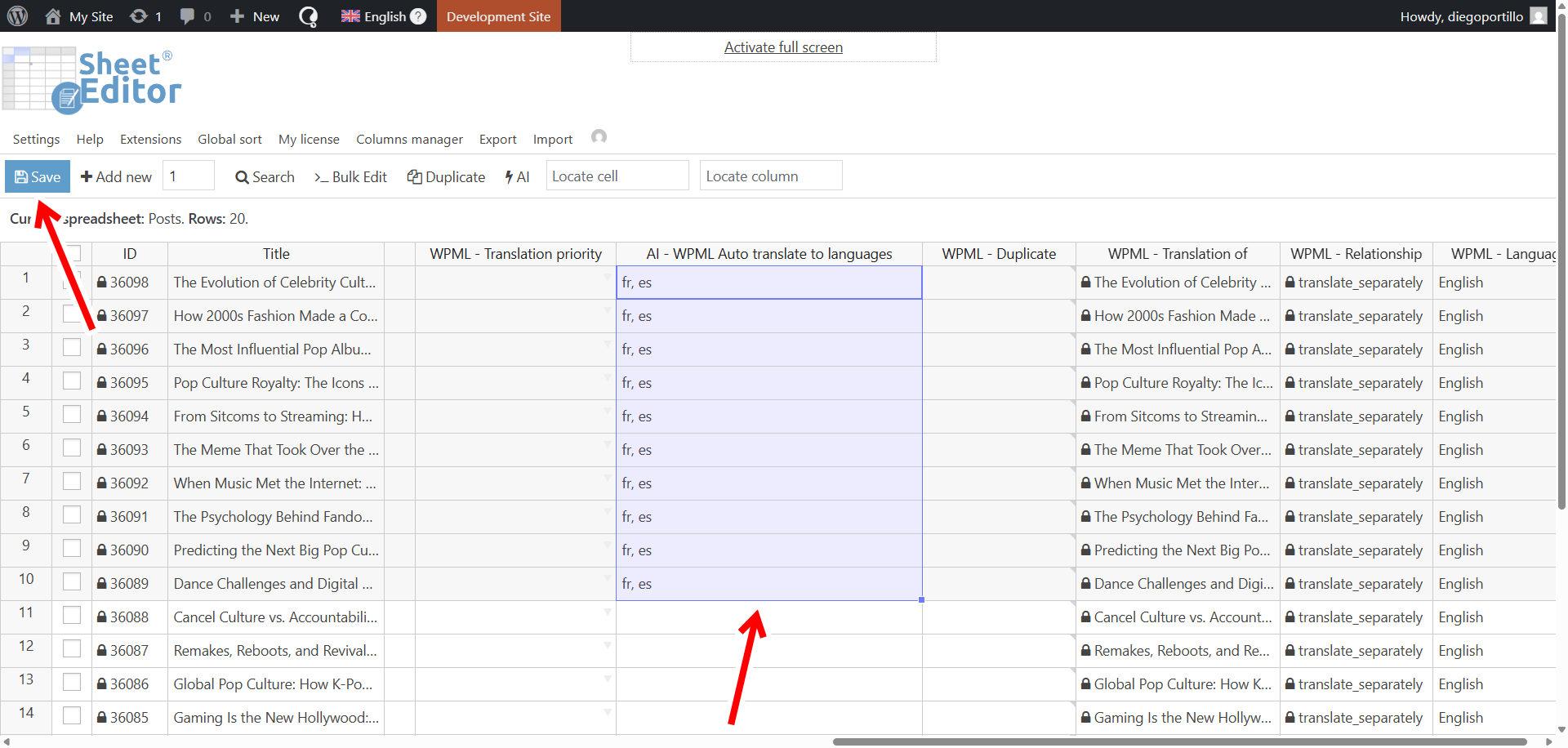
Once you’ve entered the language codes, click Save to start the automatic AI translation process. The AI will translate all fields supported by WPML, saving you hours of manual work.
Once the automatic translation process is complete, you can switch languages, and you’ll see that your post titles, content, excerpts, SEO data, etc. have been translated into the selected language.
Option 2 – Bulk translate with AI automatically
If you prefer to translate all posts at once, you can use the Bulk Edit tool.
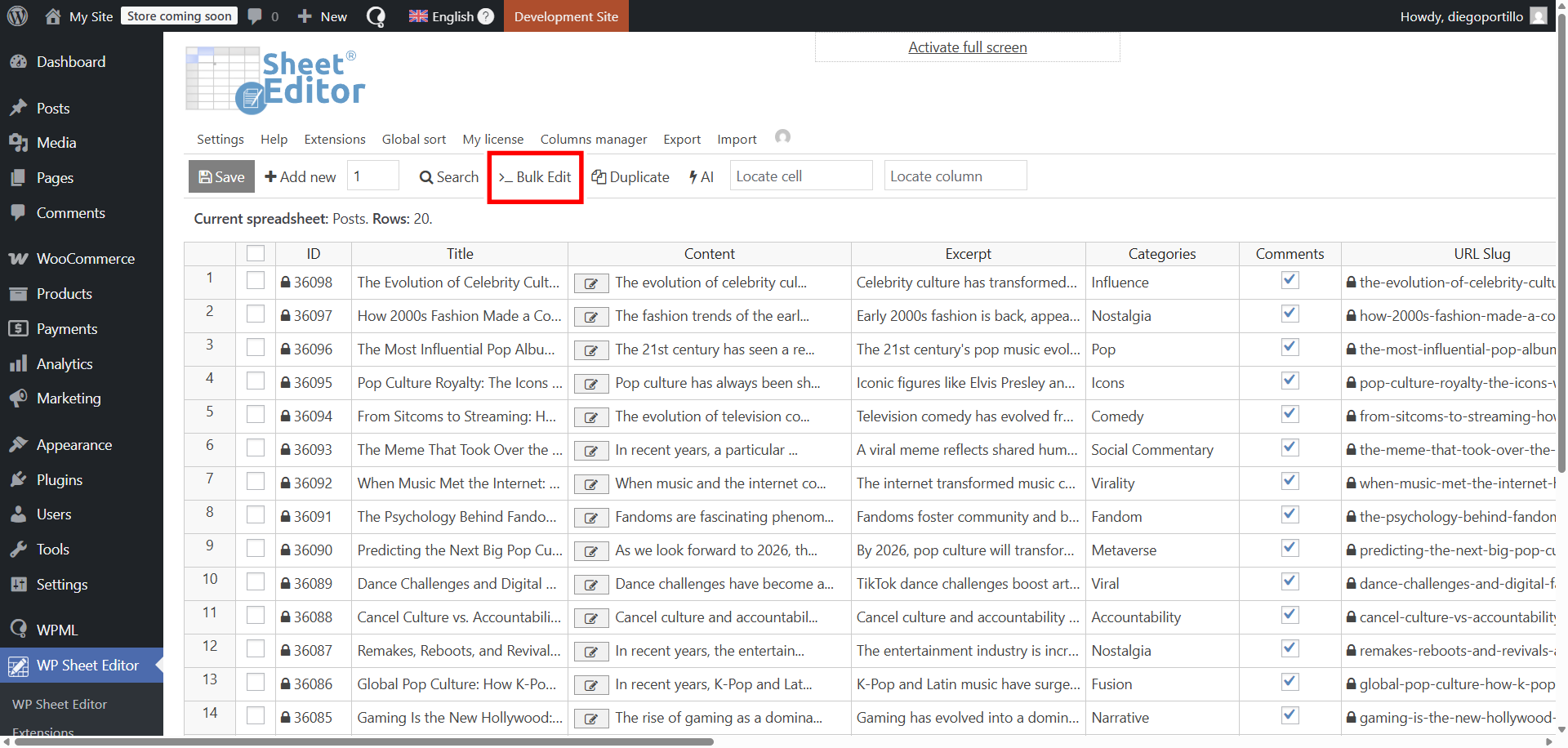
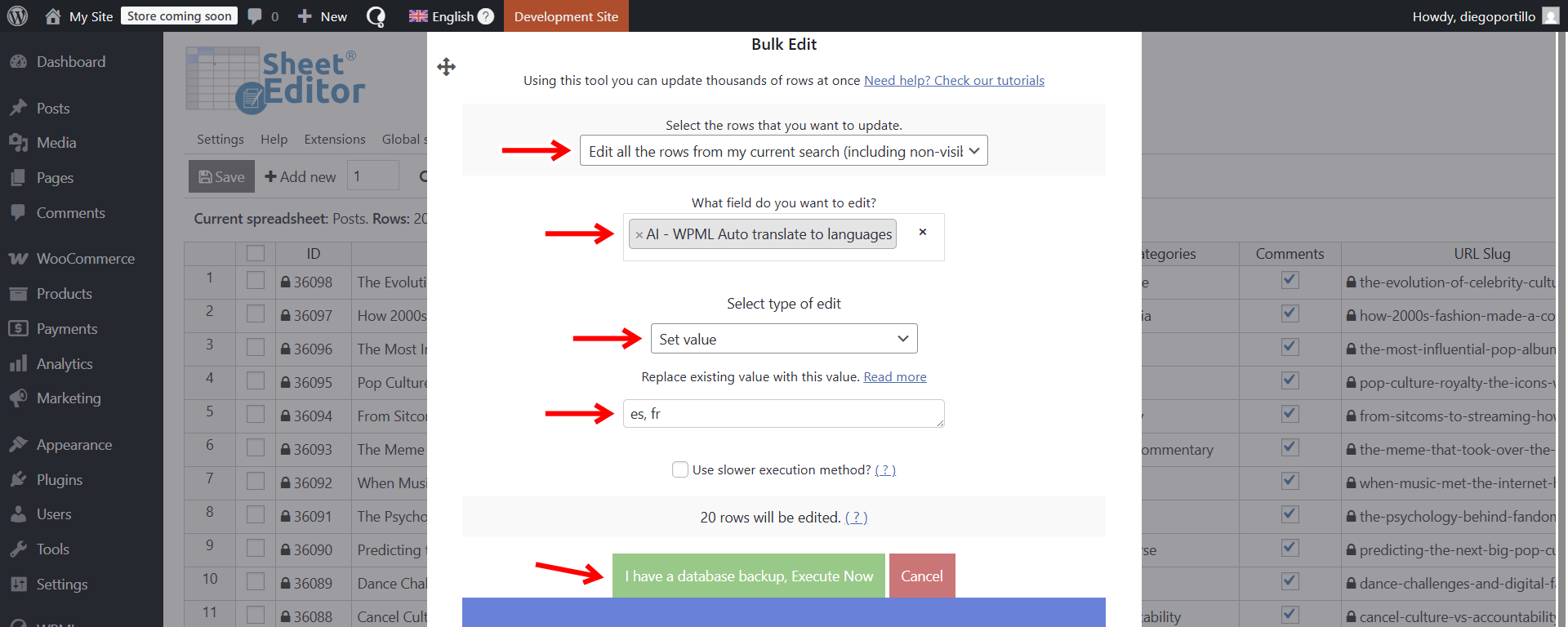
Select these values in the Bulk Edit tool to bulk translate WordPress posts with AI:
- Select the rows that you want to update: Edit all rows from the current search
- What field do you want to edit: AI – WPML Auto translate to languages
- Select type of edit: Set value
- Replace existing value with this value: Enter the language codes separated by commas (e.g., “es,fr,it”)
- Click Execute Now
Important: When running many AI prompts at the same time, WP Sheet Editor – AI uses the Bulk AI API to process them efficiently. For example, doing 10 prompts one by one might take 60 seconds, but with the Bulk AI API, it can finish in just 6 seconds. Learn more.
Frequently Asked Questions
Which fields will be translated automatically?
All fields that WPML considers translatable will be automatically translated with AI. This includes post titles, content, excerpts, SEO metadata, and custom fields.
Can I translate pages or custom post types?
Yes. The AI – WPML Auto translate to languages column works for posts, pages, products, and any custom post types that are set as translatable in WPML.
Manual AI translation of WordPress posts
While the automatic translation column is the fastest way to translate your WordPress posts, you might prefer more control in specific cases — for example, if you want to use custom prompts or translate only certain fields.
In those cases, you can use the manual AI translation process. This gives you full flexibility to fine-tune how each field is translated while still using AI efficiently.
Optional – Create global AI prompts
With WP Sheet Editor – AI, you can save your prompts for easy reuse. This way, you won’t have to type prompts every time you want to use them to translate WordPress content.
If you want to know more about global prompts, you can read this guide.
But generally speaking, if you want to create global prompts, go to WP Sheet Editor > AI > Settings > Prompts.
Once there, click on Add new to create a new prompt.

Next, add the prompt name and the prompt text.
Here are some prompts you can save to translate your WordPress posts into different languages:
Translate WordPress post titles:
Translate the $current_value$ into Spanish. Return only the translation, preserving the original case sensitivity.
Translate WordPress post content:
Translate the $current_value$ into Spanish, preserving HTML structure and formatting. Return only the translated content with all HTML tags intact and case sensitivity maintained.
Important: Make sure you customize these prompts to fit your needs. For example, change the translation language and add specific information.
Once you’ve added the prompt, click on Save.

After saving your prompts, each prompt will automatically generate a prompt slug, which will be useful to use the prompt using a shortcut in the WP Sheet Editor spreadsheet.

Open the WordPress posts spreadsheet
With WP Sheet Editor – Post Types, you can bulk manage your WordPress posts, pages, and custom post types using a spreadsheet.
In this example, we will edit the WordPress posts, so we need to go to WP Sheet Editor > Edit posts.
As you will notice, the spreadsheet displays posts based on the WPML language selected in the admin bar. For example, here we have our posts in English.

However, if we select Spanish, you will see that we still don’t have Spanish translations, so we are going to show you how to easily create them and then use artificial intelligence to translate our posts.

Create the WPML post translations
To create translations into other languages, you need to open the spreadsheet in the main language. English, in this case.
Then, you need to add the language key or code to the WPML – Duplicate column in the spreadsheet.
To do this, you have two options.
First, you can go to the column and select the languages for which you want to create translations.
WP Sheet Editor allows you to select WPML languages as tags in the spreadsheet cells.

Once you’re done selecting the languages, click on Save.

Second, you can use the Bulk Edit tool.
This is great to bulk create the WPML translations of your WordPress posts.
Start by opening the Bulk Edit tool.

Now you need to select these values:
- Select the rows that you want to update: Edit all the rows from my current search
- What field do you want to edit: WPML – Duplicate
- Select type of edit: Set value
- Replace existing value with this value: In this case, we will enter “es” to create Spanish translations. If you want to create translations into multiple languages, you need to enter the language codes separated with commas. (Read more about language keys/codes here).
- Click on Execute Now.

After executing the bulk edit, you can switch the WPML language in the admin bar, and now we have posts in Spanish, although the post titles, content and other data have not been translated yet. Now we’re ready to start translating WordPress posts using generative AI.

WP Sheet Editor – AI is the perfect bulk AI translation tool for WPML and any other WordPress multilingual environment.
In the examples below, we will show you how to translate post titles and post content. But you can follow the same steps to translate other fields such as post excerpt, SEO metadata, and any other field, including custom fields added by plugins such as Advanced Custom Fields, PODs, etc.
Here are some options to translate posts with AI.
Option 1 – Translate using global prompts in spreadsheet cells
To translate titles, content, excerpts, SEO metadata and other fields of your WordPress posts using global AI prompts, just type ai: followed by the slug prompt.
For example, if you saved a prompt to translate titles whose prompt slug is translate-title, you need to enter this in the cells:
ai:translate-title
Remember that this is just one example. You can have global prompts saved for each case. You can have prompts to translate content into specific languages, specific fields, etc. It all depends on your creativity and your needs to create and run global prompts easily.

When you hit Enter, the AI will start processing the request.

And in a few seconds, the translation of the content of the selected cell will be completed.

You want to translate multiple cells at the same time, paste the shortcut prompt into multiple cells and watch the magic.

Once you have finished translating posts with AI, save your changes.

Option 2 – Translate using full AI prompts in spreadsheet cells
If you want to use full prompts in spreadsheet cells, you can easily do so. Just enter ai: followed by the full prompt in the cells you want to translate.
In this example, we will use this prompt to translate WordPress post titles into Spanish:
ai: Translate into Spanish. Return only the translation, preserving the original case sensitivity.

As you can see, we have translated the selected cell, and you can paste the same prompt in multiple cells in order to bulk translate cells. And once you’re done, make sure to Save the changes.

Option 3 – Bulk translate WordPress posts using global prompts
As explained above, you can save global prompts that you can reuse both in spreadsheet cells and in the Bulk Edit tool.
In this example, we will show you how to translate post content into Spanish, so we will start by opening the Bulk Edit tool.

Now you need to select these values:
- Select the rows that you want to update: Edit all the rows from my current search (including non-visible rows)
- Optionally, you can edit all the manually selected rows or open the search tool and edit all the search results.
- What field do you want to edit: Content
- This is just an example of how to translate the post conten, but you can translate data in any column of the spreadsheet:
- Title
- Content
- Excerpt
- SEO Title
- SEO Description
- SEO Keyword
- Social media SEO
- Or any custom field added with third party plugins
- This is just an example of how to translate the post conten, but you can translate data in any column of the spreadsheet:
- Select type of edit: Here you need to select the pre-saved AI prompt. In this case, since our global prompt for translating post titles is “Translate content”, the tool displays that option as “AI command: Translate content”. It will list all the pre-saved global prompts.
- AI Provider: If you have set up multiple AI providers and models, you can select the one you want to use in order to complete this task.
- You can click on the Show preview button to preview the result before applying this bulk edit.
- Once you’re sure and have selected the values, click on Execute Now.
If you want to know how WP Sheet Editor – AI handles the bulk AI requests, you can read more about our Bulk AI API here.

Option 4 – Bulk translate posts using full prompts
If you don’t want to translate your posts using global prompts, but full custom prompts, you can do so.
Just open the Bulk Edit tool.
Now you need to select these values:
- Select the rows that you want to update: Edit all the rows from my current search (including non-visible rows)
- Optionally, you can edit all the manually selected rows or open the search tool and edit all the search results.
- What field do you want to edit: Content
- This is just an example of how to translate the post conten, but you can translate data in any column of the spreadsheet:
- Title
- Content
- Excerpt
- SEO Title
- SEO Description
- SEO Keyword
- Social media SEO
- Or any custom field added with third party plugins
- This is just an example of how to translate the post conten, but you can translate data in any column of the spreadsheet:
- Select type of edit: AI Prompt
- AI Provider: If you have set up multiple AI providers and models, you can select the one you want to use in order to complete this task.
- Prompt: Enter the prompt here. In this example, we will use this prompt that you can customize and use:
Translate the $current_value$ into Spanish, preserving HTML structure and formatting. Return only the translated content with all HTML tags intact and case sensitivity maintained.
- You can click on the Show preview button to preview the result before applying this bulk edit.
- Once you’re sure and have selected the values, click on Execute Now.
If you want to know how WP Sheet Editor – AI handles the bulk AI requests, you can read more about our Bulk AI API here.

This is how you can use the power of generative AI to translate your WordPress posts into multiple languages. Your WPML translation tasks will stop being time-consuming and tedious. Now you can bulk translate your WordPress posts, pages and custom post types using artificial intelligence directly in WP Sheet Editor spreadsheets.