
You can import WooCommerce products using CSV, XLSX, or XML files directly from your WordPress dashboard with WP Sheet Editor. The plugin processes imports in customizable background batches to prevent server timeouts, allows flexible matching by SKU, ID, or custom fields, and fully supports variable products and complex metadata.
Table of Contents
Step 1. Install and Activate WP Sheet Editor
WP Sheet Editor – WooCommerce Products provides a spreadsheet interface inside WordPress to view, edit, export, and import simple and variable products using CSV, Excel (XLSX), or XML files.
You can download the plugin here:
Download WooCommerce Products Spreadsheet Plugin - or - Check the features
Step 2. Prepare Your Import File
If you are updating products that already exist in your WooCommerce store, the safest method is to export your current catalog first, edit the values in your spreadsheet editor, and import the file back into WordPress. This preserves your exact product IDs, terms, and custom field structures.
You can download a sample CSV template containing all WooCommerce product types, or review our guide on how to export WooCommerce products with custom fields.
How to Export Products for Editing:
- Go to WP Sheet Editor > Edit Products in your WordPress dashboard.
- Filter (Optional): Click Search to filter by category, attribute, tag, price, or stock status. Leave blank to export your entire catalog.
- Click Export in the top toolbar.
- Select Columns: Choose All columns, Active columns, or select specific fields such as Name, Regular Price, and Stock.
- Select Rows: Choose all rows matching your search or only the rows you have manually checked in the sheet.
- Choose Format: Select CSV for plain delimited files or Microsoft Excel (XLSX).
- Click Start new export to download your file.
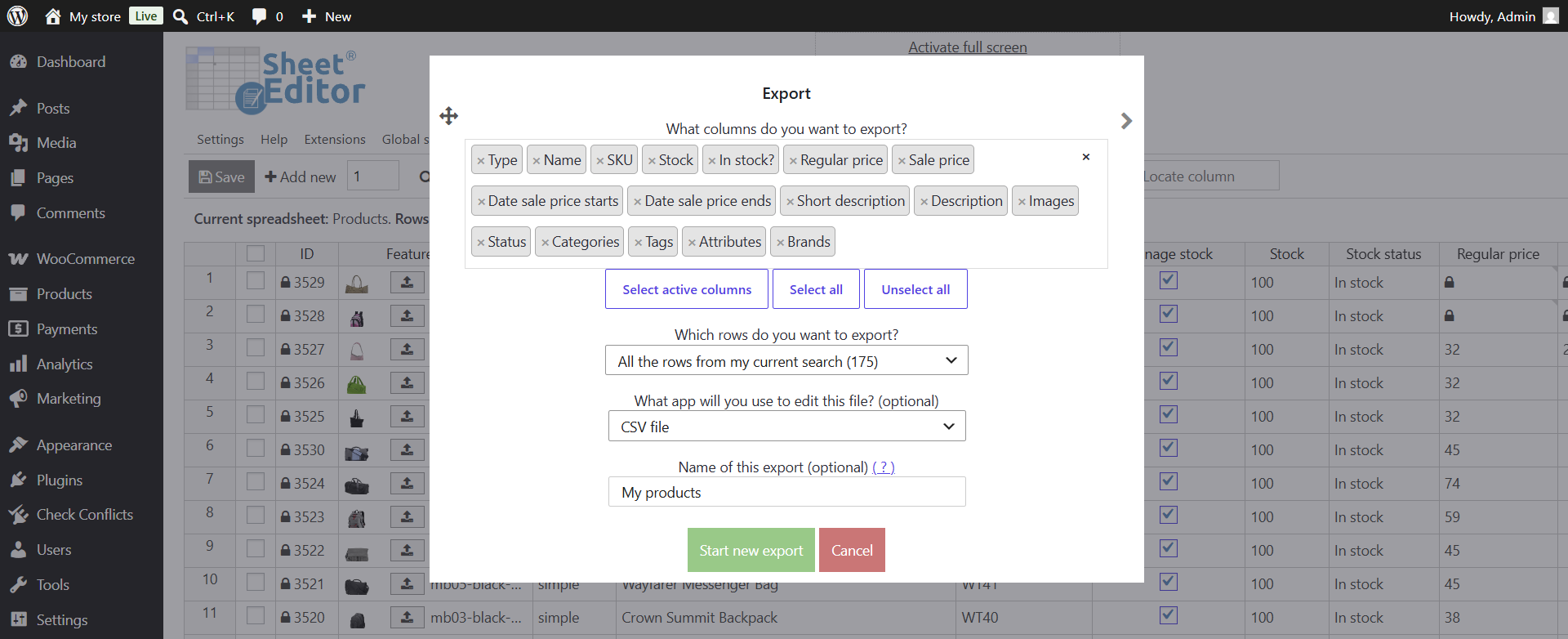
Now you have a file where you can edit existing product or add new products.

Step 3. Import Products Using CSV, XLSX, or XML
Once your file is edited and saved, click the Import button on the top toolbar of the spreadsheet.

3.1 Select Your Source File
- Source: Select From my computer (or choose a server file / URL).
- Click Choose File and upload your CSV, XLSX, or XML file.
- Click Next.
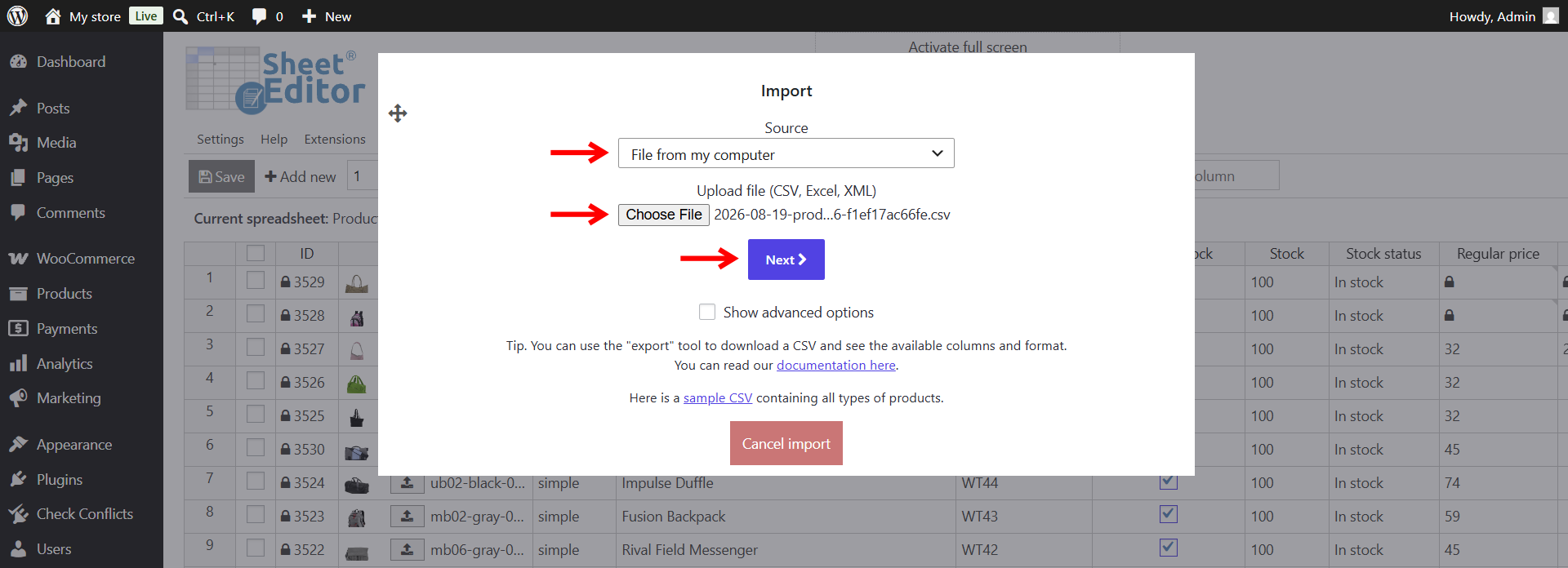
3.2 Map File Columns to WooCommerce Fields
- Import all columns: Automatically maps matching column headers to corresponding WordPress product fields.
- Select individual columns to import: Allows manual column mapping, custom field assignment, or omitting specific columns.

3.3 Configure Update and Creation Rules
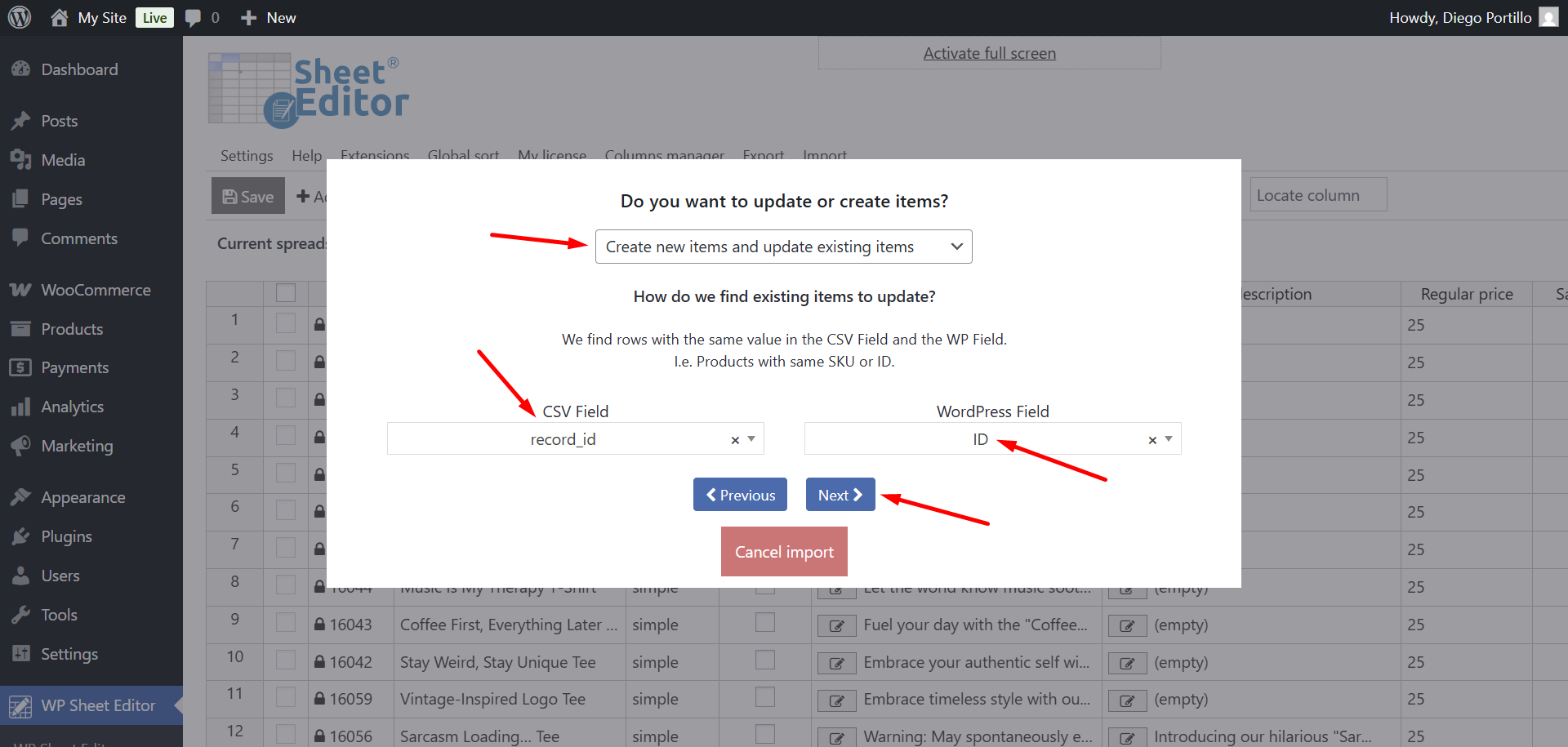
- Do you want to update or create items: Choose one of four import behaviors:
- Create items and update existing items
- Import all rows as new
- Only create new items, ignore existing items
- Update existing items, ignore new items
- Matching Field (CSV Field | WordPress Field): If updating existing items, select your unique identifier to match products (e.g.,
ID,SKU,Title, or a custom barcode/EAN field). - Click Next.
3.4 Preview and Execute Import
Review the 5-row preview table to confirm that product names, prices, variations, and custom fields align correctly with your database schema.
Click The preview is fine, start import to begin background processing.
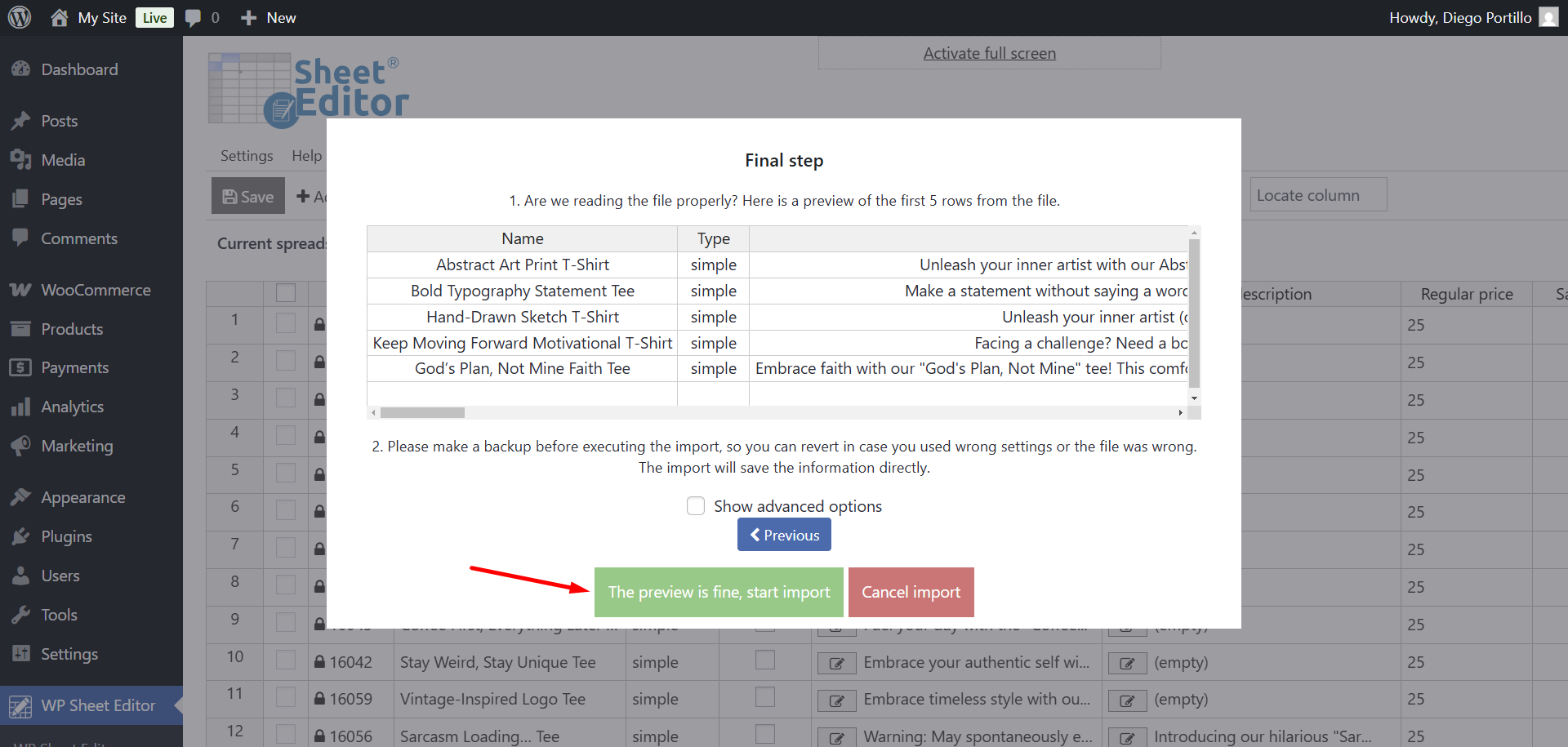
When the process completes, the summary screen displays the exact number of updated and newly created products.

WooCommerce CSV Formatting Quick Reference
- Product Images: Enter public image URLs separated by commas (e.g.,
https://site.com/img1.jpg, https://site.com/img2.jpg) or exact media library file names. Read our step-by-step tutorial to import WooCommerce products with images. - Hierarchical Categories: Separate parent and child categories using a greater-than symbol (e.g.,
Apparel > Men > Shirts). Separate multiple categories with a comma. You can configure your custom delimiter by reviewing our guide on how to fix taxonomy term separator warnings in WP Sheet Editor. - Variable Products: Ensure attribute columns list all options separated by a pipe (e.g.,
Small | Medium | Large). For complex variable setups, follow our complete guide on how to import WooCommerce variable products and variations. - Server Timeouts: If your hosting environment has strict memory or execution limits, lower the import batch size to 10–20 rows per batch in the advanced import settings.
Optional: Export and Import Products Using Google Sheets
With the Google Sheets Sync service, you can connect your WooCommerce catalog directly to Google Sheets to run one-time exports, scheduled automations, or live sync.
Export WooCommerce Products to Google Sheets
Follow our step-by-step written tutorials or watch the video walkthrough below:
- Export products to Google Sheets immediately
- Schedule automated product exports to Google Sheets
- Set up recurring product exports to Google Sheets
- Enable real-time bidirectional sync between WooCommerce and Google Sheets
Import Products from Google Sheets to WooCommerce
Choose from one of our import setup guides or watch the video tutorial below:
- Schedule automated product imports from Google Sheets
- Set up recurring product imports from Google Sheets
- Import products from Google Sheets in real time
Native WooCommerce Importer vs. WP Sheet Editor
Limitations of the Native WooCommerce Importer
- Server Timeouts on Large Catalogs: Imports run synchronously through the browser, often exceeding server execution time limits when handling large catalogs or extensive image libraries.
- Strict Format Requirements: Accepts only plain
.csvfiles, rejecting raw Excel workbooks (.xlsx) or supplier XML feeds. - Rigid Matching Identifiers: Matching is locked strictly to Product ID or SKU. You cannot match items by product title, EAN, ISBN, or supplier part numbers.
- Limited Custom Metadata: Fails to process complex relational data structures such as repeater fields or serialized arrays.
- Fragile Variation Mapping: Requires parent products to strictly precede variation rows in exact sequential order; missing parent rows can cause orphaned or broken variations.
Key Advantages of WP Sheet Editor
- Batch Processing for Zero Timeouts: Processes imports in small, adjustable batches to handle catalogs of 50,000+ products without exceeding server memory limits.
- Multi-Format & Multi-Source Support: Directly handles CSV, XLSX, and XML files uploaded from your computer, external URLs, or scheduled feeds.
- Scheduled & Cloud Synchronization: Use the Automations add-on to schedule background imports, or the Google Sheets Sync integration for live two-way updates.
- Comprehensive Custom Field Integration: Automatically detects and imports fields from Advanced Custom Fields (ACF), Pods, Meta Box, JetEngine, and custom meta keys.
- Flexible Identifier Matching: Match existing catalog items against any standard or custom database column to prevent accidental duplicate entries.