
Managing a growing WooCommerce store is a complex technical challenge. As your catalog expands, dealing with thousands of products, variations, prices, images, stock levels, and custom attributes becomes a full-time job. The administration workload increases even more when you factor in customer management—handling billing addresses, emails, phone numbers, and order histories.
The native WooCommerce interface is excellent for basic setups, but it relies on a paginated, single-item editing structure. Opening individual products or customer profiles one by one is incredibly slow and highly inefficient for store managers.
To help you optimize your daily workflow, we have compiled the most effective administration tips to speed up how you manage your WooCommerce database. These practical methods will save you hours of manual data entry.
Tips for Managing WooCommerce Products and Variations
To implement the following product management workflows, you will need to have the WP Sheet Editor – WooCommerce Products Spreadsheet plugin installed and activated. This replaces the standard paginated interface with a continuous, spreadsheet-like environment.
You can download the plugin here:
Download WooCommerce Products Spreadsheet Plugin - or - Check the features
1. Filter your products using advanced conditions
If you are using the normal WooCommerce product list, you have likely noticed that finding specific groups of products is severely limited. The default search bar only looks at titles and basic content.
For example, natively, you cannot search for products created within a specific date range. You cannot filter products by an exact price, a specific custom attribute (like “Material”), or isolate variations matching a distinct criteria.
By using the spreadsheet interface, you can access an advanced Search tool that allows you to query your database exactly how you need to. You can filter your catalog by keyword, attribute, category, tag, price, date, or stock status.
2. How do I bulk edit hundreds of products without crashing my server?
A common technical issue with WordPress is server exhaustion (like 504 Gateway Timeouts or memory limit errors) when trying to apply bulk actions to thousands of items at once. If you try to update 5,000 short descriptions using custom code or the native bulk editor, your server will likely fail because it attempts to process everything in a single request.
The WooCommerce Products Spreadsheet plugin solves this by executing bulk edits in server-friendly batches. Whether you are increasing prices by 10%, changing category assignments, or updating shipping classes across your entire catalog, the tool processes the rows incrementally. This allows your server to rest, ensuring massive updates complete successfully without errors.
3. Edit multiple products manually in a spreadsheet view
Sometimes you do not want to apply a uniform bulk edit; instead, you need to make unique changes to 50 different products. Natively, this means opening 50 different browser tabs, waiting for each product page to load, navigating to the correct field, updating the text, and clicking Update 50 times.
The spreadsheet interface eliminates the loading times. If you need to rewrite the short descriptions for 50 distinct items, you simply scroll down the Short description column, type your new text directly into each cell, and click Save once. All 50 products are updated in a single operation.

4. Review your store inventory stats directly
Effective stock control requires constant visibility. Instead of navigating away to a separate reporting dashboard to check your stock status, the spreadsheet displays vital inventory statistics right above your data grid.
This allows you to maintain context. You can actively edit your products while monitoring your total inventory counts without opening additional tabs.

5. Display and manage product variations as standard rows
WooCommerce buries variations. To edit a variation’s price or weight, you have to open the parent product, go to the Product Data box, click Variations, expand the specific variation, make the change, and save.
To speed this up, click the Display variations button on the spreadsheet toolbar. This extracts all variations and displays them as their own rows directly beneath their parent products. You can now edit variation prices, SKUs, and stock levels exactly as you would a simple product.

For more detailed workflows on variable products, read our guide: WooCommerce – Manage Large Number of Variations Quickly
6. Export and edit your WooCommerce products in Excel or Google Sheets
If you prefer to run advanced mathematical formulas or share your catalog with a supplier, you can easily pull your data out of WordPress.
The plugin features a robust Export tool that generates a clean CSV file. You can open this file in Excel or Google Sheets, apply complex formulas or bulk changes, and then use the Import tool to push the updated data back into WooCommerce.
READ: How to Import Thousands of WooCommerce Products
Tips for Managing WooCommerce Customers
Store administration is not just about inventory; it is also about client management. To utilize these customer-focused workflows, you will need the WP Sheet Editor – WooCommerce Customers Spreadsheet plugin.
This tool transforms your WordPress user list into an actionable CRM environment, exposing all billing and shipping data in a single view.
You can download the plugin here:
Download WooCommerce Customers Spreadsheet Plugin - or - Check the features
7. Update profile information for hundreds of customers quickly
If you need to update phone numbers, correct billing addresses, or fix misspelled names, doing it through the native WordPress user editor is tedious. Every field is hidden behind a separate user profile page.
With the Customers Spreadsheet, all user meta data (including WooCommerce billing and shipping fields) is displayed in columns. You can scroll through your user base, correct phone numbers or addresses directly in the cells, and click Save to apply all corrections simultaneously.
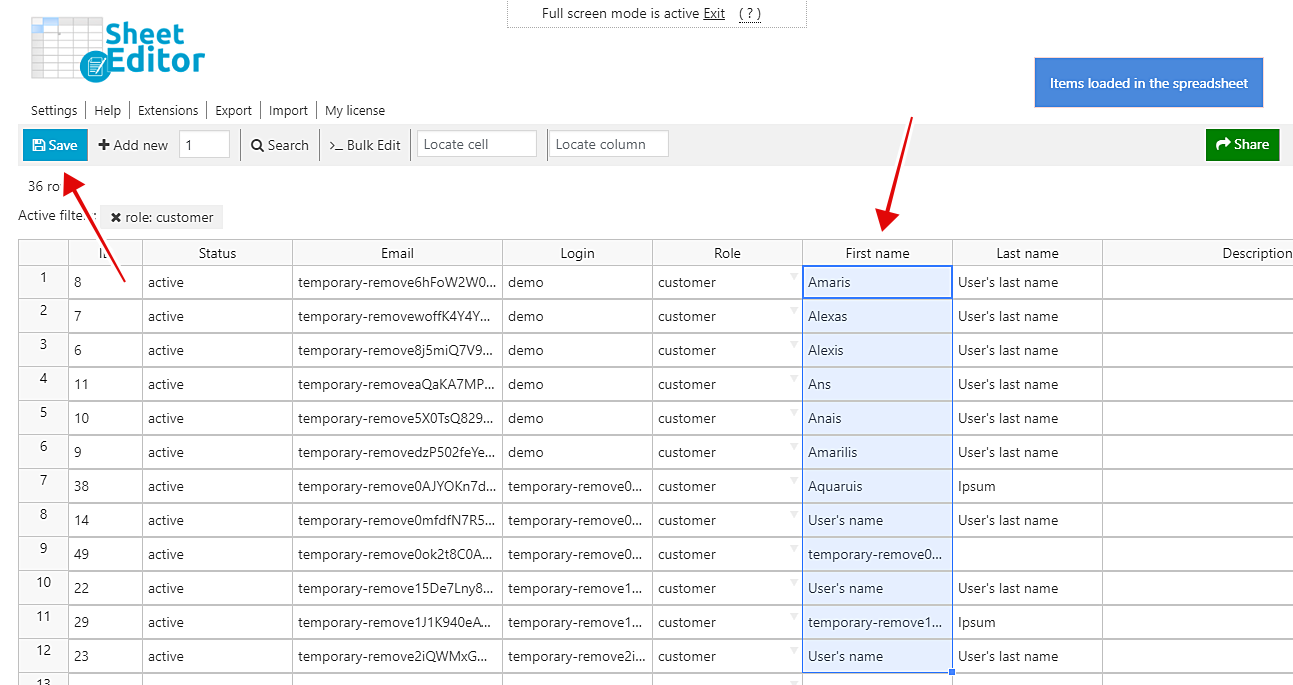
8. Isolate your customers from other WordPress user roles
A common frustration is trying to manage shoppers when they are mixed in with administrators, authors, editors, and subscribers.
To clean up your view, open the Search tool on the toolbar, select Customer from the Role dropdown, and click Run search. The spreadsheet will refresh to show only your actual buyers, hiding your staff and administrative accounts.

9. Filter customers by advanced purchasing criteria
If you need to audit your database to find customers based in a specific billing country, or isolate users associated with a particular email provider (like @gmail.com), you can use the advanced search capabilities.
You can even filter users based on their buying habits, which is incredibly useful for finding your most loyal shoppers or re-engaging inactive accounts.
Learn more: WooCommerce – How to Search Customers by Orders Count
10. Export segmented customer lists for marketing campaigns
E-commerce marketing requires clean data segmentation. When you want to run a targeted email campaign or a localized SMS promotion, you need precise lists.
The Customers Spreadsheet allows you to query your database for specific demographics (e.g., customers located in California) and export only the columns you need for your marketing software, such as First Name, Email, and Phone Number.
- WooCommerce – Export Emails of Customers From a Specific City, State, or Country
- WooCommerce – Export customer names and phone numbers by city, state, and country
Optimize Your Store Administration Workflow
Proper WooCommerce administration requires efficient tools. Natively managing thousands of products and customer profiles is a major bottleneck for growing businesses. By implementing these spreadsheet-based workflows, you can drastically reduce the time spent on manual data entry and server troubleshooting, allowing you to focus on scaling your business.